


The Best Welding Boom Arm Manufacture
Our company located in Tai'an, Shandong, China, is a machinery and equipment manufacturer with a history of 15 years. Successfully developed a welding machine space arm and a hydraulic pump station with intellectual property patents.
Why Choose Us
World-wide expertise
We know international markets and trends. Our expertise, experience and network cover all corners of the world.
Quality Control
We have built a professional QC team to accurately inspect every raw material and every process of production.
Professional team
Professional sales team and engineer team provide professional technical Support,Test video and Sample support.
Customer Satisfaction
Providing after-sales services can enhance customer satisfaction by ensuring that customers' needs are met even after the purchase. This can lead to increased customer loyalty and positive word-of-mouth referrals.
-
![Vacuum Welding Boom Arm]() Vacuum Welding Boom ArmThe welding boom is designed to place the scattered wire feeder, cable, wire feeding hose, gas pipe and other parts on the cross arm. It navigates in the space, doesn't seize the ground, and can stay
Vacuum Welding Boom ArmThe welding boom is designed to place the scattered wire feeder, cable, wire feeding hose, gas pipe and other parts on the cross arm. It navigates in the space, doesn't seize the ground, and can stay -
![Welding Suction Boom Arm]() Welding Suction Boom ArmThere are three boom arms, a main arm, a rotating arm, a forearm. The primary arm is attached to the column-mounted main boom arm pivot assembly. This enables the main boom arm to rotate up to 180°
Welding Suction Boom ArmThere are three boom arms, a main arm, a rotating arm, a forearm. The primary arm is attached to the column-mounted main boom arm pivot assembly. This enables the main boom arm to rotate up to 180° -
![Extension Welding Boom Arm]() Extension Welding Boom ArmThere are three boom arms, a main arm, a rotating arm, a forearm. The primary arm is attached to the column-mounted main boom arm pivot assembly.
Extension Welding Boom ArmThere are three boom arms, a main arm, a rotating arm, a forearm. The primary arm is attached to the column-mounted main boom arm pivot assembly. -
![Welding Auxiliary Boom Arm]() Welding Auxiliary Boom ArmThe welding boom is to install the scattered wire feeder, cable, wire feeding hose, gas pipe and other parts on the cross arm, walk in the space, do not occupy the ground, and can stay and work
Welding Auxiliary Boom ArmThe welding boom is to install the scattered wire feeder, cable, wire feeding hose, gas pipe and other parts on the cross arm, walk in the space, do not occupy the ground, and can stay and work -
![Welding Machine Boom Arm]() Welding Machine Boom ArmThere are three boom arms, a main arm, a rotating arm, a forearm. The primary arm is attached to the column-mounted main boom arm pivot assembly. This enables the main boom arm to rotate up to 180°
Welding Machine Boom ArmThere are three boom arms, a main arm, a rotating arm, a forearm. The primary arm is attached to the column-mounted main boom arm pivot assembly. This enables the main boom arm to rotate up to 180° -
![Mig Weld Boom Arm]() Mig Weld Boom ArmAll welding equipment: the welding power supply, wire feeder, welder and wire feeder settings, inert gas, welding wire, weld boom controls, and optional Hi Vacuum Welding Fume Extraction System are
Mig Weld Boom ArmAll welding equipment: the welding power supply, wire feeder, welder and wire feeder settings, inert gas, welding wire, weld boom controls, and optional Hi Vacuum Welding Fume Extraction System are

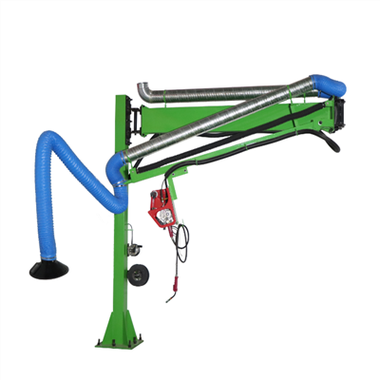


What Is Welding Boom Arm
Overhead welding booms are the kind of industrial equipment that solve multiple issues at once. MIG welding rigs are powerful machines, but their bulk makes working around large workpieces a chore. Boom arms are designed to: Reduce non-welding activities. Remove shop floor clutter.
Increased Safety
Not only do welding boom arms open up floor space, but they also increase overall safety. Less equipment in the work area means fewer tripping hazards, fewer exposed wires, and fewer tangled cables and cords to step over. This minimizes the number of potential injuries and keeps workers safe.
Higher Productivity
Less time spent pushing and pulling welding equipment around means more effort can be focused on actual welding. This increases productivity and allows projects to be completed quickly while maintaining high-quality work. Faster project completion means additional jobs can be taken on, increasing business profits and introducing new clients.
Convenience
Having every tool and piece of welding equipment you need within arms reach is an extremely convenient benefit. Pneumatic-powered tools like welding power supplies, wire feeders, inert gas, wired boom controls, welding wire, and more can be easily swiveled on boom arms and integrated into any power source. Voltage and wire speed can be adjusted anytime without bouncing back and forth between a welding machine. This added convenience not only creates an efficient environment, but it reduces stress and improves motivation among workers.
Adaptable
Welding boom arms are incredibly adaptable, allowing you to customize them to meet your shop’s needs and unique parameters. You can create the ideal piece of equipment for your workspace with various models and adjustments. Choose between mounted or mobile boom arms, whether or not you want integrated fume extraction systems that move with the arm, and even if you’d like optional air brakes.
Cracked Boom Welding Tips
Be sure to obtain the proper weld procedures from the manufacturer or someone with experience in welding.
If you're not confident in doing the work yourself, hire a certified welder. This could save you time and money in the long run.
Be sure the electrodes are clean, and in good condition. For steels having yield strengths in excess of 100 ksi (690 MPa), the electrodes must be baked in an oven at temperatures between 700 – 800 F (370 – 425 C) for at least one hour before being used. After baking, the electrodes should be kept in a storage oven at 250 F (120 C) until needed.
Weld with small electrodes using stringer beads instead of using a weaving technique. This limits the heat input into the metal which allows the steel to achieve its full strength. A weaving technique could cause reduced strength as well as re-cracking.
Prepare the area for welding by cleaning any paint, oil, rust or other debris.
Remove the crack and check it with magnetic particle or liquid penetrant testing as you won't be able to see the extended crack beneath the surface.
Be aware of the pre-heat and post heat requirements. The material should be evenly heated to the pre-heat temperature through its thickness for three inches (75 mm) to either side of the repair. Preheating to an excessively high temperature can temper the steel reducing its strength. The temperature should be monitored using temperature indicating crayons on the back side of the joint.
Do not weld in a drafty location, especially when the temperature outside is cold. Drafts quench the weld metal too quickly, resulting in re-cracking either immediately after welding or a few days later.
Wait at least a couple days before examining the final weld using magnetic particle inspection. This is because hydrogen cracking occurs once the weld has cooled.
What Specs Should You Look For in Welding Manipulators




Load Capacity
Load capacity refers to the maximum amount of load or stress that the manipulator is capable of withstanding without it underperforming.
Ideally, it’s the capacity of your manipulator to carry and to work on a particular material in terms of weight.
Column Stroke
The column stroke refers to the maximum distance or stroke in which the column is capable of moving.
Generally, the usual column stroke of welding manipulators lie around 55 to 65 inches.
Boom Stroke
Akin to the column stroke, the boom stroke is the distance that the boom is able to travel; and to give you the most general idea of the length of the boom stroke, it sits at about 39 to 50 inches.
Equipment Mass
This is the total weight of the welding manipulator.
NOTE: In checking the equipment mass, be sure to know if the attachments are included. Some manufacturers don’t include the attachments – this can result to improper weight adjustments for shipping, etc.
Power Requirement
The power requirement is what the machine needs in order for it to operate.
Unlike other specifications, the power requirement will depend on the type of motor used, as well as the functionality of the weld manipulator.
Travel Car Speed
A travel car is a component or a part of a welding manipulator that can perform long seam welding.
Travel car speed is the rate in which the travel car can go from one point to another.
These are some of the most important specifications to note in purchasing a welding manipulator. To put emphasis on it – it’s not all of them. There are far more specifications – they’re just what a wide variety of clients and customers look for often.
Welding Boom Is A Versatile Tool
Welding Boom Length: 3.1 meters, providing an extended reach for welding operations.
Bi-Directional Rotation: The boom arm can rotate 180° in both directions, allowing for flexible positioning and access to various welding angles.
Wire Feeder Trolley: The boom is equipped with a 4-wheel trolley designed to support and hold the wire feeder, helping to keep the welding area organised.
Levelling Mechanism: The top strut of the boom features a turnbuckle that can be used to level the assembly for precise welding applications.
Cable Support: Hangers along the boom allow secure and organised cabling placement, reducing the risk of tangling or tripping hazards.
Wall Mounting: Wall mount brackets are supplied with the boom, allowing it to be attached to a wall for stability and positioning.
Welder Comfort and Efficiency: Helps reduce welder fatigue and strain by improving access to the welding area and minimising non-arc time activities.
Optional Floor Mounting: An optional post (AW-POST) is available for floor mounting, giving you flexibility in setting up the boom.
Optional Base: The optional base (AW-BASE) allows you to either floor mount the unit or fit it with an optional wheel kit for increased maneuverability.
Crane Compatibility: When used with the, the AW-BASE is fitted with fork pockets, making it suitable for crane operations.
Compliance with Standards: The Welding Boom is designed and engineered to meet relevant Australian Standards to ensure safety and quality.
Finish: The boom features an enamel paint finish for durability and protection.
Assembly: The Welding Boom is supplied partially assembled, which simplifies on-site installation. However, please note that wire feeders and welding equipment are omitted and must be sourced separately.
Optional Base (AW-BASE): This base is intended for use with the AW-POST and provides the flexibility to mount the unit on the floor or make it mobile with the optional wheel kit.
Reach: The length of the boom and arm determines how far the machinery can reach. Longer booms and arms enable the machinery to reach further, which can be useful for tasks such as digging deep holes or lifting heavy loads to great heights.
Capacity: The length of the boom and arm also affects the machinery's lifting capacity. Longer booms and arms allow the machinery to lift heavier loads, while shorter booms and arms can limit the weight that can be lifted.
Stability: The boom and arm must be designed to be strong enough to support the weight they carry, while also being flexible enough to move smoothly and accurately. The design of the boom and arm can affect the stability and precision of the machinery.
Maneuverability: The arm's ability to move up, down, and side to side allows the machinery to maneuver in tight spaces and position itself precisely for specific tasks.

Applications of Boom Welding Machines
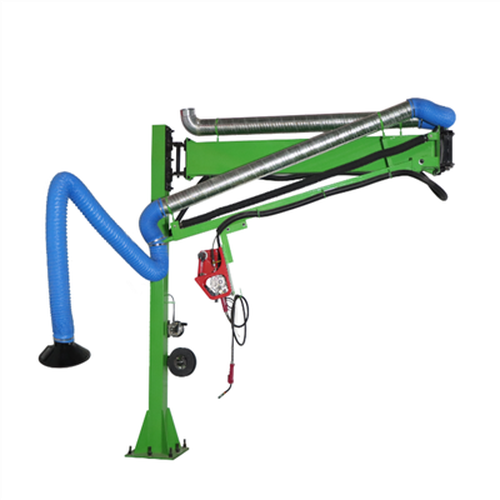
Construction Industry: Welding pipes and other structural components in construction projects, such as scaffolding, towers, and pipelines.
Power Generation Industry: Welding pressure vessels, pipes, and other components for power plants in elevated or hard-to-reach areas.
Manufacturing Industry: Welding cylindrical components in various manufacturing processes, such as water tanks, vessels, and storage containers.
Shipbuilding: Welding pipes and tubes used in the construction and maintenance of ships in shipyards and other marine environments.
Oil and Gas Industry: Welding pipelines, storage tanks, and other infrastructure in offshore and onshore oil and gas operations.
Aerospace Industry: Welding components for aircraft fuselages, pressure vessels, and other structures in aircraft manufacturing.
Medical Device Manufacturing: Welding implantable devices, catheters, and other medical components that require precise and controlled welding operations.
Selection and precautions of boom welding materials
Boom welding materials
1. Steel plate: The main material of the boom is steel plate. Choosing high-quality and suitable steel plate materials is the key to welding. Common boom steels include Q235, Q345, 16Mn, etc.
2. Welding wire: When welding the boom, commonly used welding wires include low-hydrogen steel welding wire, stainless steel welding wire, etc. Among them, low-hydrogen steel welding wire can improve the strength and toughness of the weld, and is suitable for larger booms and heavy-load conditions. Stainless steel welding wire is suitable for small parts of the boom and corrosive environments.
3. Electrode: When welding the boom, commonly used electrodes include carbon steel electrodes, low-hydrogen steel electrodes, etc. Choosing a suitable electrode can improve the quality and performance of the weld.
Precautions for boom welding
1. Before welding, the material preparation must be done well, the welding part must be cleaned, and there must be no oil stains, rust, and impurities.
2. Boom welding should be carried out in accordance with the specifications, including the selection of welding process, the setting of welding parameters, etc., and comply with relevant safety regulations and operating procedures.
3. During welding, the weld and the parent material should be fully preheated, and the welding speed and current should be controlled to ensure the welding quality and performance.
4. After welding, tests and inspections should be carried out to check whether the quality and performance of the weld meet the requirements to ensure the safe use of the boom.
How to choose suitable welding materials
1. Select the corresponding welding materials according to the material and working conditions of the boom to minimize thermal deformation and stress concentration.
2. Select different welding materials according to the requirements of different parts, such as high-strength materials for connection parts, stainless steel welding wires with good corrosion resistance for small parts, etc.
3. Select welding materials with reliable quality and excellent production technology to avoid using inferior materials and unqualified products.
- Send feedback
- Side panels
- History
- Saved
Our Factory
We continue to improve according to the feedback from the domestic and foreign markets, and now we have a full range of multi-model space arm products. The products are widely used by many well-known enterprises, which greatly improves the on-site management level and product quality of customer enterprises.

FAQ
Q: What is a welding boom?
Q: What is the purpose of a jib boom?
Q: What is a jib arm used for?
Q: What is the jib length?
Q: How is boom length measured?
Q: What is the function of the jib arm?
Q: What is the position of jib?
Q: What is jib rigging?
Q: What is boom diameter?
Q: What is a jib structure?
Q: What is a jib structure?
Q: What is the safe boom angle?
Q: What is a boom angle indicator used for?
As one of the most professional welding boom arm manufacturers and suppliers in China, we're featured by quality products and competitive price. Please rest assured to buy welding boom arm in stock here from our factory. Contact us for customized service.
dust extraction welding boom arm, electric welding boom arm, load capacity 120 kg welding boom


