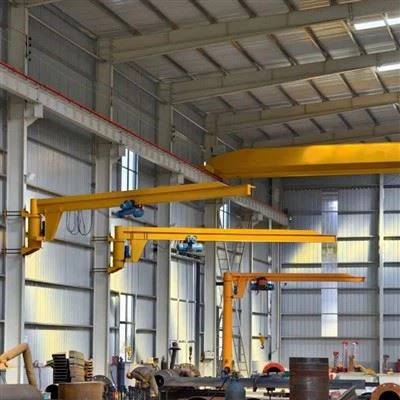

The Best Cantilever Crane Manufacture
Our company located in Tai'an, Shandong, China, is a machinery and equipment manufacturer with a history of 15 years. Successfully developed a welding machine space arm and a hydraulic pump station with intellectual property patents.
Why Choose Us
World-wide expertise
We know international markets and trends. Our expertise, experience and network cover all corners of the world.
Quality Control
We have built a professional QC team to accurately inspect every raw material and every process of production.
Professional team
Professional sales team and engineer team provide professional technical Support,Test video and Sample support.
Customer Satisfaction
Providing after-sales services can enhance customer satisfaction by ensuring that customers' needs are met even after the purchase. This can lead to increased customer loyalty and positive word-of-mouth referrals.
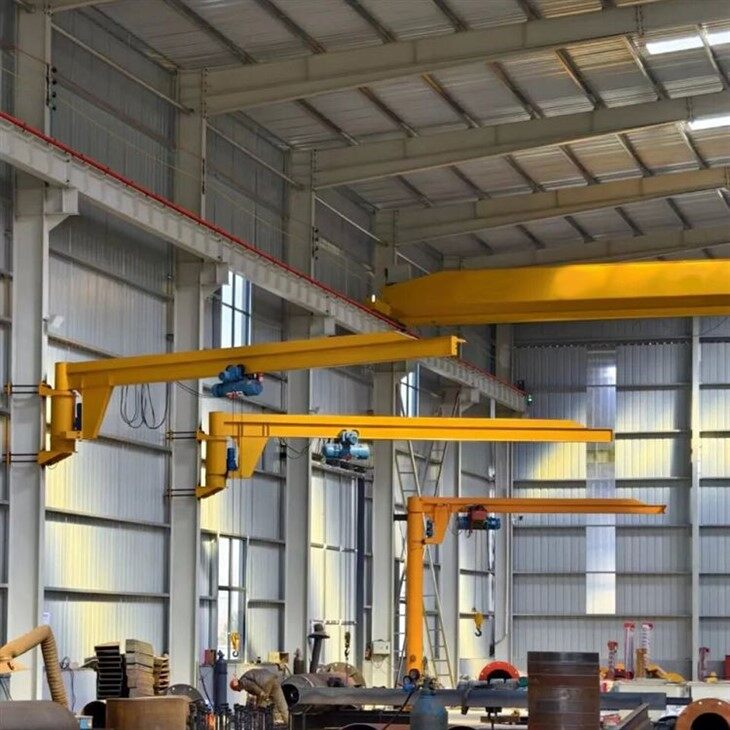
Our company located in Tai'an, Shandong, China, is a machinery and equipment manufacturer with a history of 15 years. Successfully developed a welding machine space arm and a hydraulic pump station with intellectual property patents.
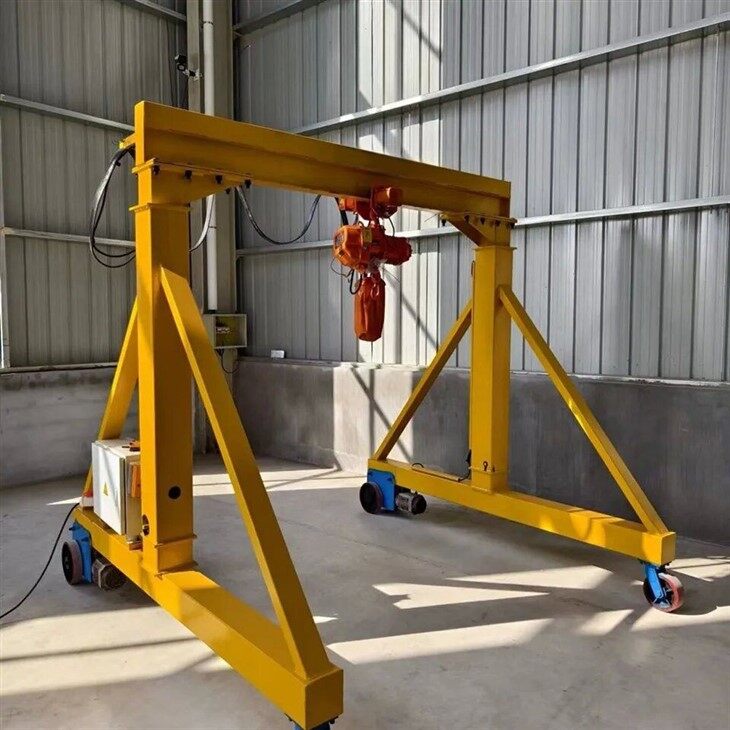
We continue to improve according to the feedback from the domestic and foreign markets
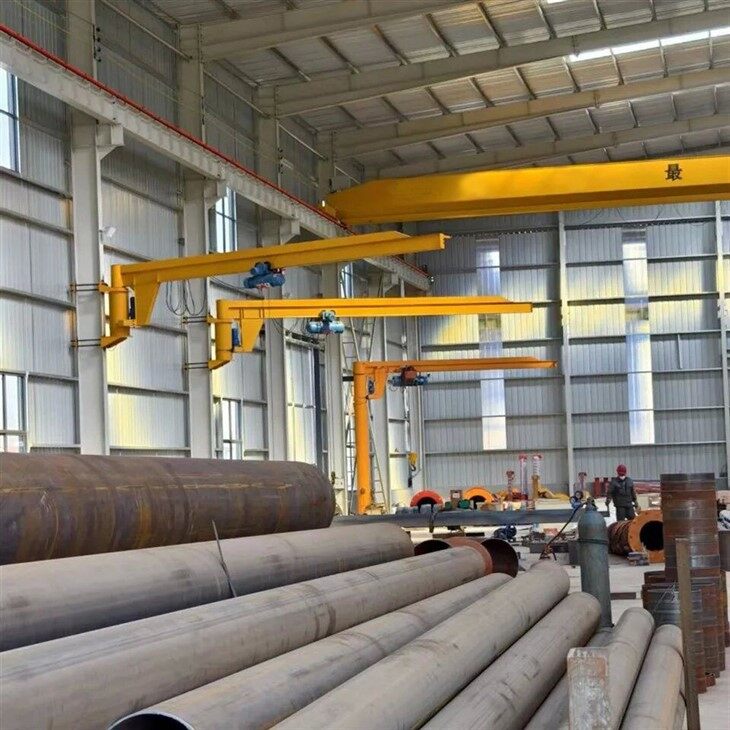
Successfully developed a welding machine space arm and a hydraulic pump station with intellectual property patents.
What Is Cantilever Crane
A jib crane is a lifting device with an arm or boom that extends off the main body of the crane to provide extra reach and has a lattice design to lower the weight added to a load. The design of jib cranes allows them to work well in small work spaces completing repetitive lifting tasks. They are extremely flexible and versatile cranes with a simple design capable of lifting 250 lbs. up to 15 tons.
Benefits of Cantilever Crane
Simple structure: The structure of the jib crane is relatively simple, mainly composed of several main components, making it easy to install and maintain.
Easy to operate: The operation of the jib crane is relatively simple and can usually be operated through the control panel or remote control, which is convenient and quick.
Strong adaptability: Jib cranes are suitable for various working environments and cargo handling requirements, and have strong adaptability.
Low maintenance cost: Due to its simple structure and fewer parts, the maintenance cost is relatively low and the service life is long.
High efficiency: Jib cranes can quickly complete loading, unloading and transportation tasks, improving work efficiency and reducing labor costs.
High safety: The jib crane has a safe and reliable control system and protective devices to ensure the safety of operators and equipment.
The mast of the jib crane should always be attached to a solid surface like a wall or floor before you try and use it. This is because it needs to be strong and stable enough to support the weight of itself and the load it will be lifting. The jib arm or boom is then attached to the mast ready for use. There are multiple different types of crane which work in slightly different ways in order to suit various applications but generally, they will all follow the same style of approach and have the same goal.
A jib crane will have three motions that you can use: rotational is the direction the boom moves around the mast, transverse is the side-to-side movement of the hoist along the boom, and lift is of course moving the load up and down as needed.
If your crane requires manual operation, you can lift your goods using either a hoist, winch, or pulley system with a chain.if you have a powered jib crane there will be controls for you to simply activate the mechanics without any human involvement
Jib Crane Design and Components
Reach/Boom – The horizontal beam that the trolley travels back and forth on.
Mast/Pillar – The vertical beam used to support the boom on freestanding and mast systems
Movable Hoist – The hoist is used to lift, position, and lower a load.
Trolley – The motion of the trolley can be manual, motorized, or pneumatic. The trolley carries the hoist, wire rope or chain, and the hook along the entire length of the boom.
Rotation – On free standing and mast type jib cranes, you can achieve 360° of boom rotation. On wall and column-mounted jib cranes, you can achieve 180-200° of rotation.
Electrification/Pneumatic Power – Electric collector rings or pneumatic air lines can be added to the top or bottom of the mast to provide rotation assistance and allow for continuous 360° boom rotation.
Controls – On motorized or air-powered jib systems, you can use a push button controller to control the rotation of the boom, as well as the motion of the trolley and the lifting and lowering motion of the hoist. Multi-speed or variable speed controls are available for the hoist and trolley.
Hook Height – How high can you or do you want to go with your lifts You'll need to know the lowest overhead obstruction to know how tall your jib crane can be.
Rotation Stop – If the crane is located close to a wall or other obstruction, a rotation stop will limit the crane's motion before it collides with a nearby object.
Environmental Considerations – The components of the jib system can be galvanized to resist corrosion for outdoor applications. Also, special control enclosures can be designed for explosion proof applications, and other environments where heat, dust and dirt, or moisture may be a factor.
Choose The right Cantilever Gantry Crane


Type of load: Different types of materials have different handling requirements, and need to be equipped with different spreaders and different types of cranes. Therefore, when selecting a cantilever gantry crane, you need to consider the type of material you plan to lift. Materials such as concrete require a crane with a higher weight capacity than lighter materials such as wood.
Capacity: You should always select a crane with a weight capacity that exceeds the maximum weight of the heaviest object you plan to lift.
Height: The height of the crane will depend on the height of the objects you plan to lift. You should ensure that the crane's height surpasses the objects' height to avoid accidents and enable smooth operation.
Span: You should take into account the width of the area where you plan to use the crane when determining the span. Ensure that you choose a crane with a span wide enough to allow free movement of the crane while lifting objects.
Construction and design: The material used for the construction must be durable enough to withstand heavy loads and harsh weather conditions. Additionally, the design should be efficient and practical, allowing for optimal use of space and ease of operation.
Safety: Ensure that the crane has all the necessary safety mechanisms, including overload protection, emergency stop buttons, and limit switches to prevent accidents and injuries.
Size and mobility: If you have limited space in your workspace, a compact crane with a small footprint may be the best option. Alternatively, if you need to move the crane around frequently, a mobile gantry crane may be more suitable.
When start to install the cantilever crane , you must confirm the vertical column installation, you should check the vertical extent from different directions. The ground must be smooth, cannot have debris, if paved the floor tiles, you must add a layer of suitable padding to increase the friction with the ground.
When you fix the silk cylinder ,the nut must be tightened, the commonly used hook wrench generally not reach the force, it is recommended When hook a wrench in front of a longer pipe, must always check if the nut is loose. Rotary arm in the column on the installation position cannot be too high or too low, too high will lead to lower column bearing capacity, leading to the down bar. Oblique arm and column angle is best within 45 degrees. Increasing the angle, arm increases, column load will increase. When swivel arm in the column, it should ensure that the rotation is flexible, you can add the appropriate grease. If the pole deformation, it should be replaced as soon as possible.
When you lift the cargo in air, please try to avoid power down, power brake will cause trembling caused by the column is a great harm, if lifting the weight, can easily lead to the collapse of the column. When the goods enter and exit the window, they should seize the cargo smoothly, and should not pull the cargo forcefully, especially when lifting a larger volume or heavier cargo.
You'd better not to lift more than 70% of the nominal weight. When you lift more higher, the weight should be reduced more.
When insert the clutch, you must ensure that the clutch is fully inserted into the air to ensure that the machine is fully closed before starting the machine, should always check the clutch when lifting
After the machine is installed, for the first time should be less hanging, check the equipment is normal, check if the nut is loose, and then gradually increase the weight. When load the goods, you cannot open the clutch, the application of motor driven goods decentralization. And pre-feet on the brakes to prevent the pulley
You should check the machine if it is abnormal frequently, and also should make it maintenance regularly, if gear damage has problems, it can easily cause the goods fall to the ground, if you can regular maintenance, it can avoid such problems.
Types of Jib Cranes
Articulating
An articulating jib crane has one boom and two swivel arms. The arms are used to reach under and into machinery and containers. One allows for 200 degrees rotation and the other 360 degrees.
They can accommodate spans of up to 16 inches, capacities up to 1 ton, and different rotation features. They are used for light tasks and can either be wall-mounted, ceiling or mounted on a bridge system.
Freestanding
This is the most popular type of jib crane. It can be installed anywhere, including both indoors and outdoors, due to the fact that it is portable.
The crane can also be used under large bridge crane systems or in small work cells. This crane can accommodate spans of up to 50 inches, up to 15 tons, 360-degree rotation, and 40-inch boom heights.
They can be divided further into categories depending on the way they are mounted and installed. The most common are base-plate mounted, foundation and sleeve-insert mounted freestanding cranes.
Foundationless
This is a type of freestanding jib that is mounted on a slab and bolted to 6-inch reinforced concrete. This crane is used indoors, and it does not require any unique foundation.
It, therefore, can be installed anywhere. A foundationless jib can accommodate 9-16-inch spans, 1000 pounds worth of weight, 360-degree rotation, and boom heights of up to 20 inches. They are easy to install, cost-efficient, and very portable.
Mast Type
Mast type are very cost-effective because they also do not require any particular kind of foundation. They only need 6 inches of reinforced concrete for support. Additional support is provided by an overhead structure or beam.
They can accommodate 10-40-inch spans, 40 tons, 360-degree rotation and 40 inches of boom rotation. They can be subdivided further into two types based on their forms of overhead obstruction.
Well Mounted
Wall-mounted cranes do not require a foundation, and they are easy to install. They can be used in individual bays, on walls, building support columns, or as a supplement to overhead bridge cranes. However, they cannot accommodate more than 200-degrees rotation. Learn about our entire range of automatic crane hooks.
Workshop and Manufacturing
- Lifting and moving materials within a workshop or manufacturing facility.
- Efficient for tasks such as assembly, welding, and machining.
Construction Sites
- On-site lifting solutions for construction projects.
- Facilitates the movement of construction materials and equipment.
Loading Docks
- Loading and unloading goods from trucks and containers.
- Provides flexibility in positioning heavy loads for efficient logistics.
Maintenance and Repair
- Lifting and positioning heavy equipment or components during maintenance tasks.
- Enables technicians to work on machinery with precision.
Warehousing
- Optimizes space utilization in warehouses for lifting and moving goods.
- Enhances efficiency in storage and retrieval operations.

Our Factory
We continue to improve according to the feedback from the domestic and foreign markets, and now we have a full range of multi-model space arm products. The products are widely used by many well-known enterprises, which greatly improves the on-site management level and product quality of customer enterprises.

FAQ
Q: What are the different types of cantilever cranes?
Q: What are the advantages of a giant cantilever crane?
Q: What is a cantilevered crane?
Q: What is the cantilever jib crane used to support?
Q: What is cantilever type?
Q: How many types of cantilever beams are there?
Q: Which crane is the strongest and why?
Q: Where are cantilevers used?
Q: What is the working of cantilever?
Q: What are the features of a cantilever?
Q: What is the difference between a jib crane and a cantilever crane?
Q: What is a cantilever hoist?
Q: What is the cantilever principle?
Q: What is the size of a cantilever?
Q: What is the function of a cantilever?
Q: What is the best material for a cantilever?
Q: How strong is cantilever?
Q: What is the rule of cantilever?
Q: How does a cantilever support loads?
Q: Why do we need cantilever?
| Crane Rotation | 360 Degrees |
| Arm Length | Up To 16 M |
| Rotating Speed | 0.5 R/Min |
| Safe Working Load | Up To 16 Tons |
| Hoisting Heights | Up To 12 (Floor To Underside Of Boom) |
| Working Tempture | -20~+40℃ |
| Travelling Speed | 20 Or 30 M/Min |
| Control Model | Pendant Handle, Remote And Cabin |
| Applications | Widely Used In All Kinds Of Industry |
| Power | AC 380V, 50HZ, 3P |
Hot Tags: cantilever crane, China cantilever crane manufacturers, suppliers, factory, cantilever crane, cranes, lifting jib crane, column crane