


The Robot Arm Manufacturer!
Our company located in Tai'an, Shandong, China, is a machinery and equipment manufacturer with a history of 15 years. Successfully developed a welding machine space arm and a hydraulic pump station with intellectual property patents.
-
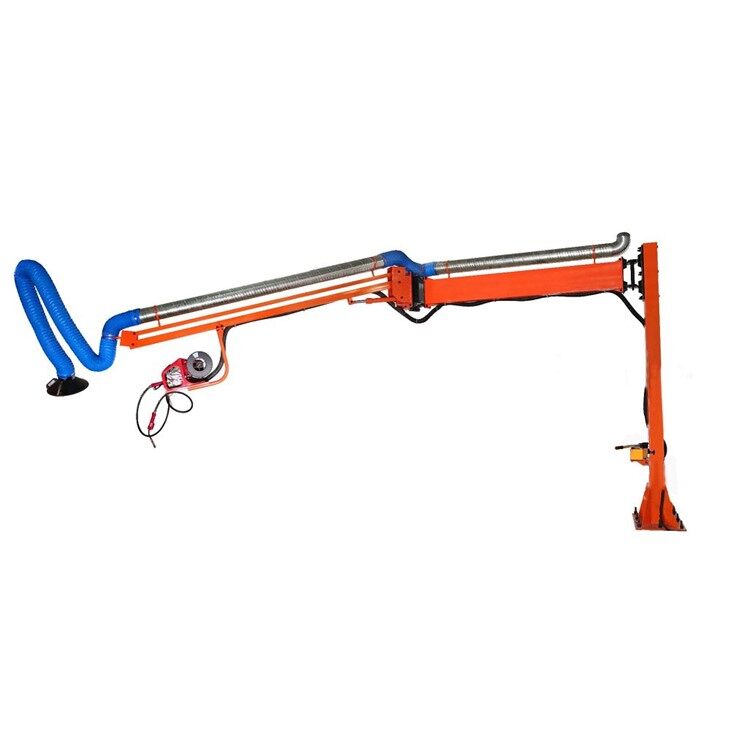
![Welding Robot Arm]() Welding Robot ArmMore time welding Clean, organized welding cell. Eliminates tripping hazards and shop floor clutter. Increased operator safety, motivation, and productivity
Welding Robot ArmMore time welding Clean, organized welding cell. Eliminates tripping hazards and shop floor clutter. Increased operator safety, motivation, and productivity -
![Feeder Robot Arm]() Feeder Robot ArmThere are three boom arms, a main arm, a rotating arm, a forearm. The primary arm is attached to the column-mounted main boom arm pivot assembly. This enables the main boom arm to rotate up to 180°
Feeder Robot ArmThere are three boom arms, a main arm, a rotating arm, a forearm. The primary arm is attached to the column-mounted main boom arm pivot assembly. This enables the main boom arm to rotate up to 180° -
![Weld Machine Robot Arm]() Weld Machine Robot ArmNo Dead Zones. No Dragging the Welder Around. No Tangled or Cut Cables.
Weld Machine Robot ArmNo Dead Zones. No Dragging the Welder Around. No Tangled or Cut Cables.


Why choose us
Product Quality
The products are widely used by many well-known enterprises, which greatly improves the on-site management level and product quality of customer enterprises.
Rich Experience
We have been in this field for more than 17 years .We have rich experience for designing and manufacturing the machinery.
Professional team
Professional sales team and engineer team provide professional technical Support,Test video and Sample support.

Quality and consistency-Robotic arms are able to provide better production quality with consistent results. They perform the tasks assigned to them the same way every time.
Greater safety-Robots can perform repetitive or dangerous tasks, especially in manufacturing. They don't get tired or forget steps in the processes they perform, so the safety risks to human workers are reduced.
Increased productivity-Robots can work 24 hours a day, 7 days a week, and they don't take breaks or lunches. This results in maximum output with speed and efficiency.
Lower labor costs-While robots can't replace human workers entirely, they can perform repetitive tasks to reduce the overall workforce and allow existing workers to focus on other areas of the business.
Types of Robotic Arms



Articulated Robotic Arms
These adaptable champions are the most common robotic arm type. With five or more joints offering a wide range of motion they are awesome in mimicking the motion of a human arm. They are great at tasks that need a lot of flexibility and dexterity, like welding and painting.
Collaborative Industrial Robots (Cobots)
Designed for safe interaction with humans, cobots bridge the gap between automation and human collaboration.
Their smaller size, lightweight construction, and safety features make them ideal for shared workspaces, assisting with tasks like material handling and quality inspection.
SCARA Robots (Selective Compliance Articulated Robot Arm)
Known for their speed and precision, SCARA robots excel in pick-and-place applications. Their unique design, featuring two parallel arms and a fixed vertical axis, allows for fast, precise movements within a defined plane.
Cartesian Robots (Gantry Robots)
These rectilinear robots move along three linear axes (X, Y, and Z), offering predictable and precise movements within a cubic workspace.
They are frequently used for machine loading and unloading and are renowned for their cost-effectiveness and ease of use.
Cylindrical Industrial Robots
Compact and efficient, cylindrical robotic arms move along a vertical axis and rotate horizontally, offering a limited but focused range of motion.
They are typically used for simple tasks like spot welding and machine tool handling in space-constrained environments.
Spherical/Polar Robots
These less common robot arms offer a spherical workspace, ideal for tasks requiring omnidirectional reach.
Although not as widely used as other types, they can be found in applications like painting and material handling.
Parallel/Delta Robots
Designed for high-speed applications, these parallel industrial robots leverage a unique, parallelogram-based design to achieve exceptional speed and precision.
They are often used in food processing, packaging, and other fast-paced tasks.
Anthropomorphic Robots
Although uncommon in industrial settings, these robots possess exceptional dexterity and resemble humans in that they have two or more arms.
Though still under development, they hold promise for future applications requiring human-like interaction and manipulation.
Components of Robot Arm
|
Joints and actuators |
Powered by electricity, pneumatics or hydraulics, actuators allow the joints of the robotic arm to bend, twist and turn to provide the necessary movements to complete a task. |
|
Links |
Links connect the robot's joints and determine the reach of the robotic arm. |
|
Sensors |
Housed within the arm, sensors provide “awareness” to the robotic arm, so it knows the location of its joints, what direction they are moving and what action they are performing. |
|
Controller |
The controller “talks” to the robot and integrated system, guiding the activities of the robotic arm. |
|
End of arm tooling |
Designed for a particular task, end of arm tooling, end effectors or grippers serve as the “hand” at the end of the robotic arm. End of arm tooling is used to grasp, grip, pick up and otherwise manipulate the part, component or tool that the robotic arm must handle. A camera on a robotic arm can also be used for inspection. |
Robotic Arms Used In Industry

Welding
Welding requires great precision and accuracy, and it's perfectly suited to automation through robotic integration. Industrial robotic arms are commonly fitted with different types of welding tools , and they can be used for TIG/TAG and MIG/MAG welding tasks.
Material Handling
An industrial robotic arm can be fitted with a range of tools that allow them to lift and move different types of materials. This material handling function is often used to move large or bulky materials that would be hazardous for employees to lift or move by hand.
Palletising
Industrial robotic arms are well suited to picking up items and palletising them. They are commonly employed in warehouses and at the end of conveyor belts to automate the process of stacking goods on pallets so they're ready for shipping.
FAQ
As one of the most professional robot arm manufacturers and suppliers in China, we're featured by quality products and competitive price. Please rest assured to buy robot arm in stock here from our factory. Contact us for customized service.
welding robot arm, robot arm


